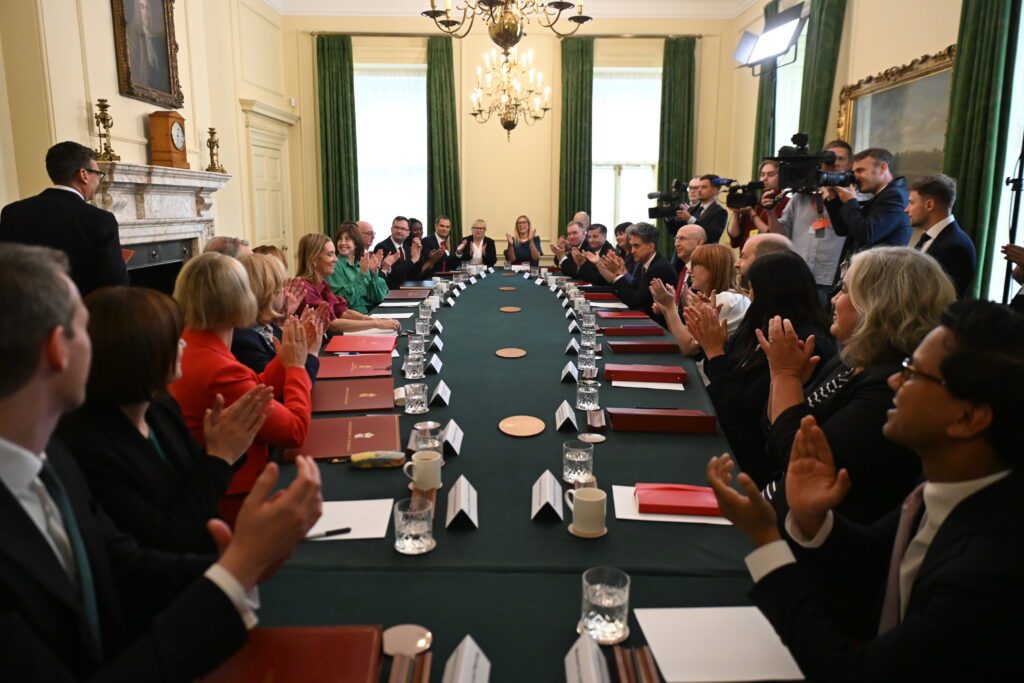
LONDON — Andy Burnham has promised not to try and “out-Reform Reform” — but that hasn’t stopped him making clear overtures to Nigel Farage’s voters.
The U.K.’s newly-installed prime minister faces an almighty challenge to bring Brits who drifted to Reform UK during Keir Starmer’s premiership back to the Labour fold. POLITICO’s Poll of Polls has the right-wing populist party a full five points clear of Labour at the time of writing.
POLITICO rounded up seven times Burnham has tried convincing voters who’ve drifted to the right that Labour deserves a second chance.
1) Staying out of the EU
Last year, the then-Greater Manchester mayor said he’d like to rejoin the European Union within his lifetime. But then reality struck.
At the outset of his by-election campaign in Makerfield — which voted heavily for Brexit — this May, Burnham said reentering the Brussels orbit is a battle he wouldn’t fight.
Despite calling Brexit “damaging,” he stressed “the last thing we should do right now is re-run those arguments.”
Burnham said his own calls to strengthen democracy would be undermined “if we don’t respect that vote.”
2) Slamming the Whitehall ‘blob’
Burnham has attacked the British state, arguing real power is vested in around 50 people with “London-centric views” at the heart of officialdom.
Though praising the civil service as “full of good people,” Burnham has said they’re held back by a “structure and the culture” which is “too adversarial.”
Reform UK has also spent plenty of time pitching itself against the Whitehall machine. It has proposed a major civil service headcount reduction,giving ministers the power to fire civil servants and replacing the impartial top post of cabinet secretary with a political chief of staff.
3) Backing British
Burnham wants to revive areas outside London which he argues the Westminster bubble has left behind for decades.
He’s already started work on a No. 10 Downing Street North in Manchester tasked with regenerating towns, increasing public control of utilities and expanding industry, arguing that “growth cannot be ordered from the top down.”

But Burnham has also called for industrial policy to “safeguard sovereign manufacturing and production capability … in critical sectors like steel, defense, energy, food and farming.”
Reform UK also takes a pretty forthright tone on economic sovereignty. Treasury Spokesperson Robert Jenrick says a Reform government will “unashamedly back British firms, buying British wherever possible.”
Farage also backed the nationalization of British Steel days before Keir Starmer’s government passed emergency legislation giving ministers control of its operations in April 2025.
4) Keeping Shabana Mahmood’s immigration reforms
Shabana Mahmood — who angered some in her own party with a push to tighten immigration rules — has been kept in the Home Office by Burnham to “finish the job.”
The home secretary is trying to pass legislation that includes limiting how the European Convention on Human Rights applies to asylum cases, and increasing removals of people refused asylum.

Though these proposals attracted criticism from some Labour MPs, Burnham voted for Mahmood’s bill during its first stage in parliament. This suggests he wants to neutralize Reform UK’s ability to paint Labour as soft on the borders.
5) Proposing a coastal minister
Wait and see if this one happens: Burnham talked about creating a minister for coastal communities.
Under questioning from Labour MPs before he took power, Burnham suggested a distinct role in government that covers this brief.
Labour won many seaside constituencies in their 2024 landslide — but those seats, which cover the East Anglia, Kent and Cornwall coastlines, are also vulnerable to Reform UK. Farage himself has made the seaside town of Clacton his political home as an MP (and now by-election candidate).
6) Praising Farage
Burnham has said he wants to reduce political point-scoring, and started as he means to go on.
“You’ve got to admire Farage’s communication skills,” he told the Times on the eve of becoming prime minister.

For a party that’s painted the veteran Brexiteer as a soft-on-Putin populist, that’s at least a nod in the other direction.
7) Scrapping digital ID
Burnham’s first big policy announcement was abolishing Keir Starmer’s scheme to introduce digital identification for all Brits.
Ipsos polling earlier this year showed support for digital ID was mixed — but, among 2024 Reform UK voters, 63 percent opposed the scheme with just 23 percent in favor.
Source: Politico Europe — This article was automatically imported from the source. Read full article at original source →
