In Kentucky and West Virginia, rescuers freed trapped residents as states face catastrophic floods and damage
Tropical storm Bertha made landfall in St Bernard parish, on the Gulf coast south-east of New Orleans, Louisiana, on Wednesday afternoon, the US national hurricane center said.
The Miami-based forecaster added that maximum sustained winds were estimated to be 45mph (75km/h) with higher gusts.
The weakening storm had been creeping along the coast, but still spinning off strong winds far from its center and closing beaches from Florida to Mississippi. Bertha is the second tropical storm of the Atlantic hurricane season that is now unfolding.
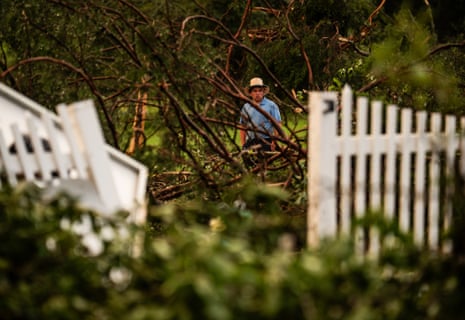
Elsewhere, a band of extreme weather that ripped through states including Kentucky and West Virginia on Tuesday night sparked devastating tornadoes and record flash flooding that left dozens of people trapped in their houses and vehicles, and injured several others.
First responders in one West Virginia county were overwhelmed by the volume of calls as waters rose to unprecedented levels, with rescuers cutting through attic roofs to free those inside. Patrick Morrisey, the governor, placed all 55 counties under a state of emergency. He sent 100 national guard members to the hardest-hit areas in the northern part of the state, and an additional 200 national guard members were due to arrive on Wednesday.
“State and local agencies will remain on the ground for as long as it takes to help affected communities,” Morrisey said in a statement.
In Kentucky, there were reports of multiple tornadoes, flooding, landslides and widespread damage to infrastructure, including a bridge that was swept away.
The threat from extreme weather conditions continued through the mid-Atlantic region on Wednesday, AccuWeather said, after damaging winds also stretched into New Jersey, New York, Ohio and Pennsylvania.
“By Wednesday, the severe weather threat will shift southward, focusing on southern Delaware and southeastern Maryland into central and southeastern Virginia, and central and eastern North Carolina,” the weather outlet warned in a bulletin.
Officials in Buckhannon, West Virginia, were assessing damage early on Wednesday after flooding they described as “catastrophic”. MetroNews, citing data from the National Weather Service (NWS), said the Sand Run stream crested at 10.63ft (3.24 meters) on Tuesday night, surpassing the 8.3ft mark set during floods in 1985.
Local media in Upshur county reported “chaotic radio traffic” between first responders and scenes including: “People hanging from trees. Bridges destroyed. Roads washed out. Structures floating down creeks. Entire families in the water. Cars abandoned. Houses colliding into one another.”
Robbie Skinner, the Buckhannon mayor, told MetroNews on Tuesday night: “I’ve never seen anything like this, and I’ve lived here for 37 years. The river is still rising, we’re not done yet.”
Outlets reported that water rescue crews in swift boats were moving from property to property cutting holes in roofs to free people trapped in their attics, and dozens of people being evacuated by boat from a flooded hotel.
Tens of thousands of customers were still without electricity in Ohio, Virginia and West Virginia on Wednesday morning, poweroutage.us said, with many more having been restored.
Some of the worst damage from tornadoes came in Kentucky. Multiple people were injured in Grayson county, officials there said, one with serious injuries requiring hospital admission. Up to 25 buildings were severely damaged or “completely gone”, Carey Sims, the county’s director of emergency management, told WDRB News.
The NWS office in Louisville said in a post on X that it planned to conduct damage surveys in at least four areas and across seven counties of the state on Wednesday morning.
The Associated Press and Reuters contributed reporting
Source: The Guardian World — This article was automatically imported from the source. Read full article at original source →