In the early 1980s, the personal computer market was a raucous bazaar, teeming with variety. Each distinct type of personal computer—from Atari, Radio Shack, Apple, Commodore, Texas Instruments, and many more—had its own sub-culture of clubs and magazines, full of partisans ready to tout the superiority of their chosen machines.[1]
Though a substantial bloc of smaller manufactures such as North Star and Vector Graphic all supported an Altair-compatible hardware standard (8080-compatible processor and S-100 bus) and Gary Kildall’s CP/M operating system, they were far from a monopoly share. Standards in graphics, sound, and peripheral connections varied even more widely. Most microcomputers used processors compatible with Intel’s 8080 or MOS Technology’s 6502, but the BASIC programming language was the only near-universal lingua franca, often pre-installed in read-only-memory (ROM) chips on the computer and usually supplied by Microsoft.
Over the course of the 1980s, the IBM PC and its successors paved over all of that, leaving behind a near-uniform cookie-cutter subdivision of compatible computers. By the end of the decade only fragmentary remains attested to the lost world that preceded it: the antiquated Apple IIs still populating school computer labs; the strange boxes at the electronics store labeled “Amiga” and “Atari ST” (the last gasps of dying giants); the Macintoshes found in the offices of graphic designers, writers, publishers, and other members of the cultural avant garde.
The full story of how that unfolded will have to wait for another volume. For now, we will see how it began, with the launch of the IBM Personal Computer in 1981. Ironically, the ecosystem was closed by openness.
Ever since Thomas Waston, Junior launched International Business Machines (IBM) into the electronic computing market in the 1950s, the company had become nearly synonymous with the idea of the computer. Though many of their offerings were technically impressive, especially the breakthrough System/360 line launched in 1965, their success rested mainly on the comprehensiveness of their product line and their unmatched sales and service departments. Though not quite so dominant as it had been in prior decades, the IBM of 1980, with 40% of the global computer market, was still a powerhouse—the popular press routinely called it a “colossus.” To other computer makers, it was simply “the environment”; to be in the business was to swim in IBM’s sea.[2]
IBM’s greatest strength lay in large, mainframe computers. It could not dominate everywhere along the ever-expanding digital frontier, swarming with upstarts staking out new territories for minicomputers, software, dedicated word processing systems, and more. Each market segment had its own leading companies—smaller than IBM individually, but collectively a grave threat to its position as the center of gravity of the computer business. When it came to the very small computers that were selling in the hundreds of thousands by 1980 and projected to continue growing at an astonishing 40% per year, IBM had nothing at all to show for itself.[3]
IBM leadership had known since the early 1970s that the plummeting cost of electronics would make it practical to dedicate an entire computer to a single user. The problem was translating that knowledge into a product that would reach a mass audience. In 1973, IBM engineer Paul Friedel launched a single-user computer project that became the IBM 5100, a fifty-pound, all-in-one computer and terminal for scientists and engineers. In 1983, its creator tried to claim the 5100 as the “missing link” in personal computer history, but with a starting price of $9,000, it hardly belongs in the same forest as the Altair, let alone in its family tree.[4]
The 5100 did not have a microprocessor (which most computer engineers in 1973 still considered far too feeble an instrument to power a real computer). It ran on a multi-chip processor developed out of the IBM office in Boca Raton, Florida, about an hour north of Miami, which housed IBM’s Entry Level Systems Division. As the personal computer rose and rose in the second half of the 1970s, it became obvious in Boca Raton (and even in the airy heights of IBM headquarters in Armonk, New York) that to maintain its reputation as a leader in the world of computing, IBM had to respond. In 1978, the Florida office started work on the System 23/Datamaster, a true microcomputer based on the 8-bit Intel 8085 (a variant of the popular 8080). But two years into that project, it remained mired in development, weighed down by a succession of changes mandated by leadership to align the product with other parts of the company. It was also obvious based on its cost structure that the Datamaster would cost far more than leading personal computers like the Apple II and TRS-80.[5]
Forty-year-old Boca Raton executive Bill Lowe was so disgusted with this state of affairs that in July 1980 he went before the corporate management committee in Armonk and declared that IBM was culturally incapable of producing a personal computer; they would have to slap the IBM logo on a white-label device from the likes of Apple or Atari to bring anything to market. This may have been a gambit intended to force corporate to give him a free hand, but it was not all bluster; there had certainly been talks about selling an Atari computer under IBM livery.[6]
Whether in accordance with Lowe’s plan or not, IBM CEO Frank Cary refused to accept that there was any kind of computer that IBMers couldn’t build. He “decided that the assumptions behind these machines [the 5100 and Datamaster] were the problem. His executives were all assuming that the systems would use only IBM technology, that they’d be sold only by IBM salesmen, that they’d carry all the standard IBM service policies.” An internal study had found that procuring the physical parts alone for a personal computer through the normal IBM channels would cost more than the computer’s target retail price. Cary’s solution was to give Lowe carte blanche to develop a personal computer within a newly invented corporate structure, the Independent Business Unit. Lowe would report directly to the CEO and be shielded from all corporate politics. He had one month to come back with a proposal that would deliver a saleable computer in one year. Internally, the initiative was called Project Chess and the device the Acorn; externally IBM would call it simply the IBM Personal Computer (PC).[7]
Lowe, a corporate climber who had been moving up the IBM ladder since 1962, soon saw the chance to grab another rung: the sudden heart attack of the head of the Rochester, Minnesota office put him in line for a Vice Presidency. He quickly dropped Project Chess, which had already served his purposes by raising his profile with corporate leadership, to pursue this new opportunity. Responsibility for the development of the IBM personal computer thus fell into the lap of Don Estridge.[8]
Slightly older than Lowe, Estridge appeared to have a much less bright future at the company. After stints on the SAGE air defense project and the Apollo project, he eagerly put down roots at the newly opened Boca Raton office in 1969, back in his native state of Florida. Rebelling against the “I’ve Been Moved” company culture, he had no interest in leaving home again to chase promotions. He was also coming off of a rocky “Series 1” minicomputer project that had nearly sunk his career. It was salvaged from financial ruin only by a lucky order from State Farm Insurance.[9]
Nonetheless, Estridge had two qualities that made him perfectly suited to bring Project Chess to fruition. First, the fact that he held the norms of IBM management culture in low regard. He wielded his direct line to the CEO as a talisman to ward off vice-presidential demands and bureaucratic process, and in so doing prevented the lightning sprint to a 1981 launch from bogging down into a multi-year slog. Second, he had insight into the target market because he belonged to it: he had bought an Apple II in 1977 and, like thousands of his fellow hobbyists, tinkered on it in the evenings after work.[10]
Estridge protected his people from pressure to use only the IBM dealer network and IBM suppliers. They would sell the PC through third-party retailers—most importantly, ComputerLand. And, though IBM factories were allowed to put in their bids like everyone else, the Acorn would be built mostly from third-party parts: disk drives from Tandon, power supplies from Zenith, printers from Epson, and a processor from Intel. Even after the release of the PC, internal IBM suppliers would be forced to compete with outside vendors for business: to bootstrap an ecosystem as quickly as possible, Project Chess would follow in the footsteps of Apple and publish all the technical specs needed to allow and encourage third parties to write software and create hardware accessories for their new computer.[11]
Intel was a natural choice for the processor, because many of the engineers in Boca Raton had already become familiar with Intel hardware from the Datamaster project’s 8085. But Estridge’s hardware team wanted to move up to a sixteen-bit processor from the eight-bit processor of the Datamaster (and the vast majority of microcomputers than in use). Doing calculations in sixteen-bit chunks would make the Acorn 1 more efficient at data processing and (most importantly) allow it to support larger amounts of memory. Intel offered the fully-sixteen-bit 8086, but the Chess team chose the hybrid 8088, which processed sixteen-bit chunks internally but communicated with the external word (over its “data bus”) eight bits at a time. This would substantially reduce the overall cost of the machine, since eight-bit support chips were much more common and less expensive to produce.[12]
Even as they were settling these major hardware problems, the Chess team began its search for software. Jack Sams, tasked with heading up this effort, wanted the Acorn to support two modes of operation, both very popular in the personal computing world: running BASIC from read-only memory (ROM) for simple programming tasks and games, and running a disk-based operating system like CP/M from Digital Research for word-processing, accounting, and heavy data-processing tasks.[13]
Sams was tasked with finding suppliers for this software, and he went first to a name he already knew and trusted: Microsoft, which provided the BASICs installed on most of the major brand names in the personal computer market. In August 1980, he met with Microsoft’s principals, Bill Gates and Paul Allen, in Seattle. Aware that aligning themselves with IBM could prove very lucrative, they eagerly agreed to supply their BASIC and any other software IBM might require (they ultimately provided several other programming language packages as well as Microsoft’s version of the increasingly musty Colossal Cave Adventure). When asked about licensing CP/M, however, Gates had to regretfully decline. Microsoft had no rights to CP/M, but he was happy to phone up Gary Kildall at Digital Research in Pacific Grove, California, and arrange a meeting.[14]
Much has been made of this fateful meeting, on August 22, 1980, to which Kildall, unlike the solicitous Gates and Allen, arrived hours late. The negotiations about licensing the yet-to-be-released sixteen-bit CP/M-86 thus fell to his business manager (and wife) Dorothy Kildall. Though the events of that day are much disputed, it is certain that everyone walked away unhappy, and no deal was reached. But IBM had no one else to turn to, and so negotiations continued. The ultimate outcome (a triumph for Microsoft and the eclipse of Digital Research) was determined not by the events of that day, but by the predispositions of the three main parties.[15]
Sams disliked the standoffish attitude of Digital Research and had wanted, in the first place, to deal only with the supplier he already trusted: Microsoft. As for Gates and Kildall, though they both loved computers, and had once briefly considered a merger of their companies, they had very different personalities. Gates had been angling to build a business since he was in high school; he and Allen created Microsoft to meet a market need: a BASIC interpreter for the Altair, which they believe would sell like hotcakes. Kildall had created CP/M as the incidental byproduct of a hobby interest: his desired to write PL/M code on a microcomputer. For better or worse, he lacked Gates’ relentlessness and drive. He certainly wanted to do well for himself, but he cared more about building interesting software than winning in the market, and he disliked IBM’s attitude more than he liked their money. The Digital Research of the 1980s would never have become the Microsoft of the 1990s, no matter what happened on August 22nd.
The facts of how these dynamics played out were as follows: a frustrated Sams went back to Gates to ask again about a disk operating system. Through Allen, Gates knew of one other possibility: a 16-bit CP/M clone created by a local company, Seattle Computer Products (SCP). In 1979, SCP had started selling an S-100 compatible motherboard for the Intel 8086 processor, designed by employee Tim Paterson. But unlike in the ancient of the Altair, by 1979 most hobbyists expected to have a disk operating system available for their computer. So, Paterson wrote one, which he called Quick and Dirty Operating System (QDOS), and which SCP sold externally as 86-DOS. It was a near-perfect clone of CP/M for the 8086. Because the 8086 and 8088 used identical machine code, this meant it would also work on the IBM personal computer.[16]
Gates offered to put Sams in touch with SCP, but the dealings with Digital Research had already exhausted his patience with microcomputer software makers. He asked Gates to do the deal himself and license 86-DOS to IBM. Gates duly did so (all the while concealing the existence of his deep-pocketed customer from SCP) and then worked diligently to make sure Microsoft could deliver exactly what IBM wanted, in plenty of time for the 1981 PC launch—he even hired Paterson away from SCP to polish 86-DOS into what IBM would call PC-DOS. But the crucial moment for Microsoft came in July 1981, when Gates convinced SCP’s owner to sell him all the rights to 86-DOS, in exchange for $50,000 and a perpetual license back to SCP. Because IBM had not secured an exclusive license to PC-DOS, Microsoft could now sell it to others, giving this same piece of software its fourth name, MS-DOS. This deal was the basis for Microsoft’s future multi-billion-dollar empire.[17]
With Digital Research threatening to sue over the similarities between PC-DOS and CP/M-86, IBM agreed to offer the latter as an additional operating system for the IBM PC. But this alternative did not actually become available until April 1982, months after IBM launched its computer, and because Digital Research demanded per-copy royalties (while Microsoft licensed DOS for a flat fee), it sold for $240, six times as much as PC-DOS. This was not the end of Digital Research, which found a niche in the operating system market and survived until 1991, when another software maker, Novell offered $80 million to buy the company. The previous quarter, Microsoft had made $140 million in profit.[18]
The IBM PC debuted on August 12, 1981, in a press conference at New York’s Waldorf Astoria hotel, almost exactly a year after Lowe had committed to delivering it. The Chess team had estimated one million units in sales in the first three years, but corporate planning, unable to credit such a figure, cut the target down to 200,000, which restricted supply in the back half of 1981. Nonetheless, after three years, the PC was right on target for one million sold. Estridge rose from obscurity to become an overnight star: having “delivered nearly $1 billion of revenue, that, not being in anyone’s business plan, appeared to come out of thin air… Estridge’s bosses looked at him as something of a magician.”[19]
An ungenerous historian might credit the PC’s success solely to the IBM name: businesspeople skeptical of the microcomputer fad (or uncertain whether existing brands could be trusted to last) felt comfortable betting on a machine to which this venerable, trusted brand had lent its credit. And there is certainly truth to that. As soon as he heard the IBM PC was coming, Martin Alpert, president of a small technology company in Cleveland, shifted his whole business on making add-ons for the computer. He spoke for third-party vendors as a whole when he said that “people wanted a standard. They didn’t know what to buy until they heard about the IBM PC and they figured they couldn’t go wrong because it was IBM. As soon as we saw the machine, we believed in it and we bet the future of our company on it.”[20]
Yet it is also true that the PC would never have succeeded so well had it not also been an excellent, forward-looking design, which combined many of the best features of its competitors. As BYTE’s senior editor wrote, it had “color graphics like the Apple II, an 80-column display like the TRS-80 Model II, a redefinable character set like the Atari 800, a 16-bit microprocessor like the Texas Instruments TI 99/4, an expanded memory space like the Apple III, a full-function uppercase and lowercase keyboard like the TRS-80 Model III, and BASIC color graphics like the TRS-80 Color Computer…”[21]
The most important of these features were the sixteen-bit microprocessor and the expanded memory access, which went hand in hand. Most 8-bit computers could read from or write to a maximum of sixty-four kilobytes of memory (by combining two eight-bit addresses). The Apple III had quadrupled this with a technique called bank-switching, but the IBM, with sixteen-bit addresses plus a four-bit segment identifier, could access an entire megabyte (though applications could access only 640 kilobytes—later a notorious number—with the rest reserved for system software and input/output devices). One would be hard-pressed to find a microcomputer user in possession of so much memory in 1981, but with prices falling and application software growing ever more sophisticated, business users would soon both want that much memory and be able to afford it, and the PC was well-prepared for that eventuality.[22]
By the spring of 1983, IBM’s personal computer sales already matched those of Apple and Tandy. Andrew Pollack of the New York Times noted that “an entire subindustry has sprung up to supply parts, accessories and advice for the I.B.M. personal computer,” and that “I.B.M.’s role in the personal computer world is beginning to resemble its central role in the mainframe computer business, in which I.B.M. is the sun around which everything else revolves.” A new catalog of IBM-specific literature sprung up to serve this new market: David Bunnell, who had left MITS (creator of the ALtair) to found Personal Computing, now became editor-in-chief for PC Magazine, entirely dedicated to IBM’s new computer. Many brands (from Dumpster to Kleenex) had found their proprietary name transformed into a generic label, but IBM had managed to turn the previously generic term “personal computer” into the proprietary acronym “PC.”[23]
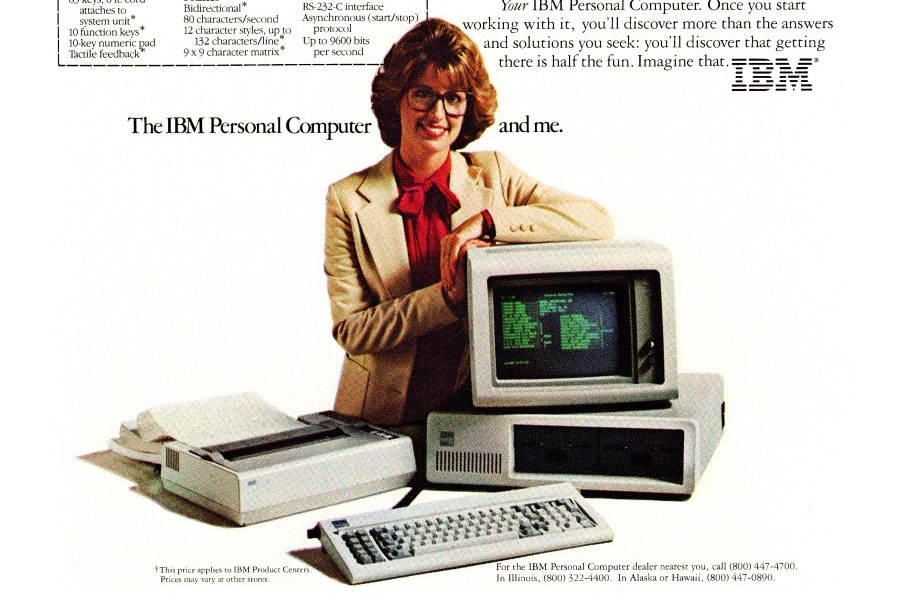
The PC’s open architecture, borrowed from minicomputers via Apple and the Altair-compatibles, attracted software and hardware vendors and kicked off a new flywheel of success even more powerful than the one that propelled the Apple II. As much from necessity as from calculation, Estridge’s team had blended the open traditions of the personal computer and the authority of IBM’s imprimatur into an enticing cocktail. Both conformists and rebels could find something appealing in its flavor. The marketing campaign struck the same chords: “My own IBM computer. Imagine that,” went one tagline. Now you could have complete control over your own computer without giving up the assurance of the IBM brand.[24]
Yet, this concoction that so enchanted its drinkers also proved dangerous to the brewer. An open architecture was more easily copied, and by March 1983, more than 20 “clones” of the IBM PC already existed, “interchangeable or almost interchangeable with the I.B.M. computer.” Internally, IBM executives seethed at the press focus on Don Estridge, who generate only a small fraction of IBM’s revenue while hurting the rest of the company “by not trying to tie his products into the rest of the company’s, by not working with the IBM sales force, or by not being willing to buy his parts from IBM.” In short order, the full force of internal politics was unleashed on the formerly sheltered PC group. The immediate successor models to the PC, 1983’s XT and 1984’s AT, both sold terrifically, but darker times loomed ahead. After its magician died in a horrific plane crash in Dallas in 1985, IBM would dig deep into its hat but never produce another rabbit.[25]
The full story of IBM’s downfall will have to wait for another series. But in the next post we will look at the consequences of the IBM PC’s arrival for the rest of the industry.
[1] Petri Saarikoski and Markku Reunanen, “Great Northern Machine Wars: Rivalry Between User Groups in Finland,” IEEE Annals of the History of Computing (April-June 2014), 16-26.
[2] John Greenwald, “The Colossus that Works,” Time (July 10, 1983); Kathleen Burton, “Anatomy of a Colossus, Part II,” PC Magazine (February 1983), 327; Katharine Davis Fishman, The Computer Establishment: The Inside Story of America’s Most Dynamic Industry (New York: McGraw-Hill, 1981), 14-18.
[3] Kathleen Burton, “Anatomy of a Colossus, Part II,” PC Magazine (February 1983), 327.
[4] Paul J. Friedl, “SCAMP: The Missing Link in the PC’s Past?”, PC Magazine (November 1983), 191-197; James Chposky and Ted Leonsis, Blue Magic: The People, Power and Politics Behind the IBM Personal Computer (New York: Facts on File), 1988. Unfortunately, Blue Magic, the only book-length account of the creation of the IBM PC, is filled with errors and confusions (To give just one example, page 7 credits the creation of the modem to Dennis Glayes of Glayes Microcomputer Products. Setting aside the accuracy of the core claim, the more glaring error is the bizarre typo: the correct name is Dennis Hayes). I have attempted to cross-check all of its claims with other sources, where possible.
[5] Chposky and Leonsis, Blue Magic, 17-18; Paul Carroll, Big Blues: The Unmaking of IBM (New York: Crown Publishers, 1993), 22; David J. Bradley, “The Creation of the IBM PC,” BYTE (September 1990), 414. On release in 1981, the Datamaster in a basic configuration with a printer included cost nearly $10,000. “IBM Combines Data and Word Processing,” Personal Computing (October 1981), 154.
[6] Chposky and Leonsis, Blue Magic, 9-10; Paul Carroll, Big Blues, 1; Marty Goldberg and Curt Vendel, Atari Inc.: Business is Fun (Carmel, NY: Syzygy Company Press, 2012), 607; Stephen Manes and Paul Andrews, Gates: How Microsoft’s Mogul Reinvented an Industry—and Made Himself the Richest Man in America (New York: Touchstone, 1994), 150. None of these accounts of what happened prior to and during the management committee fully agree but all are consistent with some discussion between Lowe and Atari.
[7] Chposky and Leonsis, Blue Magic, 8-10; Carroll, Big Blues, 56-57; Kathleen Burton, “Anatomy of a Colossus, Part II,” PC Magazine (February 1983), 327.
[8] Chposky and Leonsis, Blue Magic, 58-59; Carroll, Big Blues, 26.
[9] Chposky and Leonsis, Blue Magic, 30-31; Carroll, Big Blues, 27-28.
[10] Chposky and Leonsis, Blue Magic, 32; Carroll, Big Blues, 28-29.
[11] Chposky and Leonsis, Blue Magic, 68, 73, 88-91; Carroll, Big Blues, 36.
[12] Bradley, “The Creation of the IBM PC,” 414, 416.
[13] Jimmy Maher, “The complete history of the IBM PC, part one: The deal of the century,” Ars Technica (June 30, 2017) [https://arstechnica.com/gadgets/2017/06/ibm-pc-history-part-1]
[14] Manes and Andrews, Gates, 150-155.
[15] Manes and Andrews, Gates, 155-156; Maher, “The complete history of the IBM PC, part one.”
[16] Manes and Andrews, Gates, 157-158.
[17] Manes and Andrews, Gates, 159-160, 174-175; Jimmy Maher, “The complete history of the IBM PC, part two: The DOS empire strikes,” Ars Technica (July 31, 2017) [https://arstechnica.com/gadgets/2017/07/ibm-pc-history-part-2/].
[18] Manes and Andrews, Gates, 173, 192; Jim Edlin, “CP/M Arrives,” PC Magazine (June/July 1982), 43; David Laws, “Oral History of Tom Rolander” Computer History Museum (December 12, 2016), 26-27; Paul Andrews, “A Career Spent In Gates’ Shadow — Computer Pioneer Dies At 52,” Seattle Times (July 14, 1994); John Markoff, “PC Software Maker Novell To Buy Digital Research,” New York Times (July 17, 1991); Andrew Pollack, “Microsoft’s Net Up 73% in the 2d Quarter,” New York Times (July 25, 1991). Some accounts, including Manes and Andrews’, attribute the $240 price to intentional IBM sabotage.
[19] Carroll, Big Blues, 40, 44.
[20] Chposky and Leonsis, Blue Magic, 105, 114.
[21] Gregg Williams, “A Closer Look at the IBM Personal Computer,” BYTE (January 1982), 36.
[22] Bradley, “The Creation of the IBM PC”, 417.
[23] Andrew Pollack, “Big IBM Has Done It Again,” New York Times, March 27, 1983.
[24] “My own IBM computer. Imagine that,” Personal Computing (January 1982), 4.
[25] Andrew Pollack, “Big IBM Has Done It Again,” New York Times, March 27, 1983; Caroll, Big Blues, 44, 59, 66.
View all posts by technicshistory
Source: Hacker News — This article was automatically imported from the source. Read full article at original source →

