This project made for a perfect lazy Saturday unwind, after a busy week giving a talk at Devrelcon in NYC. Makerworld had this thing as one of their featured models about a week or two ago, and the parts came in while I was away.
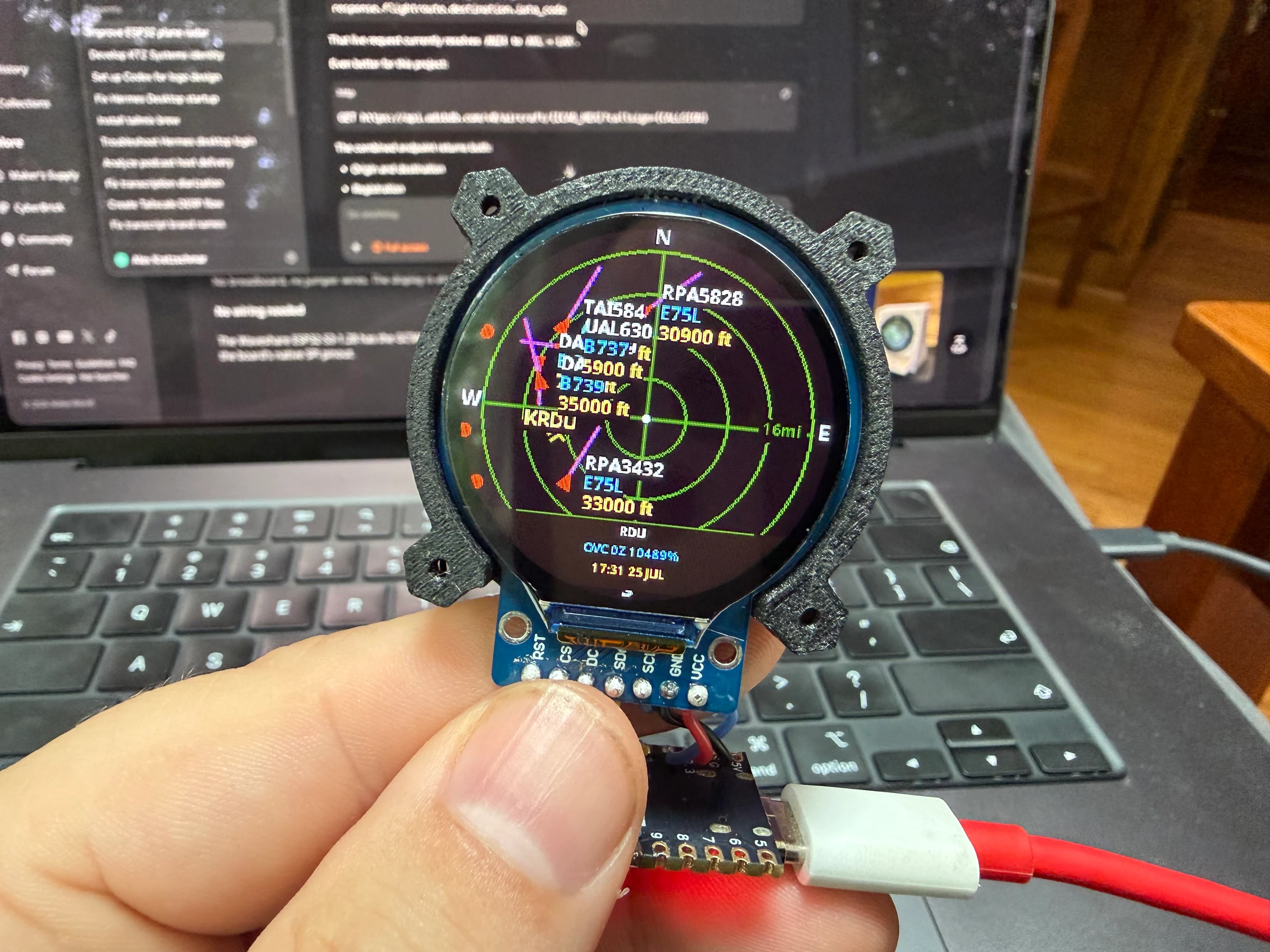
Plane radar is a neat little project that turns an ESP32-C3 and a 1.28-inch round display into a live aircraft radar. It pulls nearby ADS-B traffic, plots each aircraft by distance and bearing, and shows the details directly on the screen.
It was an easy build, although it did require a little soldering. I always enjoy doing that as it reminds me of my days building racing drones. Thin, silicone based wires made quick work of the cabling. And after about 15 minutes, we were ready to go.
It is insanely easy to flash firmwares to a fresh esp32 these days using the browser-based ESPHome web flashing tool. Under 30s and you’re done.
The original model was featured on Makerworld, because it looks great. Reality though was, in practice, it’s not actually that great.
Unfortunately the tolerances are just too tight to be usable with the batch of boards I got. So I’m likely going to model my own replacement at some point, but for now I ended up printing this model instead.
I’ve spent today improving my fork of ESP32 Plane Radar project, with the help of pure vibes.
The biggest improvement is proper flight context. Where the data is available, aircraft now show their origin and destination instead of just their tail number, with the callsign used as a fallback. Aircraft types are also more descriptive, something like B737-800 rather than simply B737. I added local weather, temperature, humidity, time and date as well.
The web interface can now modify coordinates after initial setup. Display options can now be changed without resetting the Wi-Fi configuration, and there are controls for units, runways, weather, temperature format and 12/24-hour time. Text is 10% larger by default, with a persistent 80–130% slider for adjusting it.
Finally, the firmware now supports authenticated OTA updates, so future builds can be installed through the browser instead of connecting the board over USB.
I’ve compiled, flashed and tested everything on the actual device, and the latest work is committed to the main branch. Next up will probably be porting it to a larger display and designing a tidy 3D-printed enclosure for it.
Source: Hacker News — This article was automatically imported from the source. Read full article at original source →